
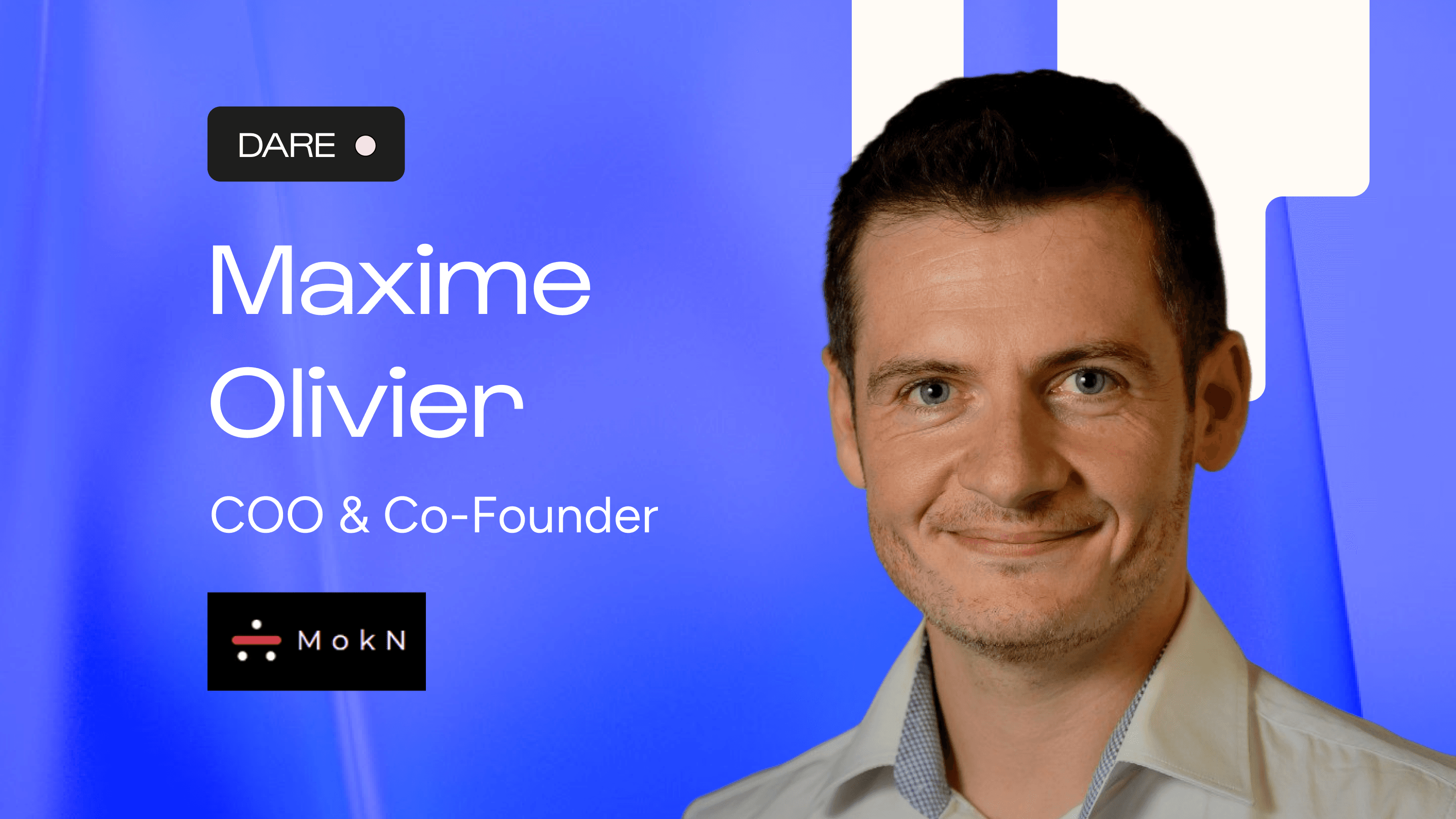
DARE #7 - Maxime Olivier - COO @Mokn
Jan 14, 2026
Sometimes, we meet people who inspire us. Who make us believe that another approach is possible. Who take us on their energy.
"DARE." is the series of optimists. Those who have the courage and creativity to continually reinvent our businesses and daily lives.
Dive into the universe, strategies, and methods of those who are making waves.
Strong personalities for concrete interviews.
The 3 concrete pieces of advice I take away from our exchange:
1️⃣ Define embodied values and give total autonomy: if your employees stay within the framework of values, there won't be any bad decisions.
2️⃣ There is no validation without action: set the strategy quickly and jump right into action and tactics.
3️⃣ Kindness = kindness + courage: the courage to speak up and continually build on others' work.
Framework
Did a decisive moment steer you towards a career in cyber?
I discovered the cyber world in my first year of my master's program. I was in a classic computer science program, and I saw that there was a Cybersecurity option. What I liked was the playful aspect: I discovered challenges, the first encryption algorithms, little puzzles, a bit of math... I found that initial approach pretty cool.
So, I did my M1 and then my M2 specializing in cybersecurity. It was in 2009. At that time, there were only 4-5 programs. The graduating class had twelve people. We were probably a hundred people coming out of a dedicated path on the subject, on a national scale. We were not many.
But I had dipped my toes into it, and I was never going to come out again.
What do you think it comes down to?
I think it’s the love of a challenge, the love of puzzles.
It’s this constant enigma with understanding technical subjects to know how to divert them, it has just always fascinated me.
And ultimately, it’s always a bit like that: finding the weakness, understanding how the system works. You could almost compare it to an Escape Game. It’s like a game. When you do penetration testing, it’s the same logic: finding the door, finding the opening…
Very clear for Cyber. And what led you to entrepreneurship?
I’m not quite sure where it comes from. I don’t come from a family of entrepreneurs, strictly speaking, but it came to me early!
My upbringing probably has something to do with it. I’ve always learned to make choices and then take responsibility for them. It was a very strong notion in my family: if you make a decision, you see it through to the end. I think that has greatly shaped my ability to take risks; to not stop once you’re started.
Otherwise, maybe my past as an athlete left me with seeds of competitiveness. I did quite a few table tennis competitions.
It’s this combination of factors that matured and pushed me to start projects. It materialized when I took the lead of the Junior Enterprise at the university, before firmly rooting itself when I entered the working world.
I quickly had a very bad experience with a manager who simply acknowledged the issue. I decided to take matters into my own hands. That’s when I started my first company.
What happened?
When I arrived, it was still a very small company. There were about 6 or 7 of us.
The founders at the time always allowed me a lot of freedom in starting projects. I launched many activities and projects.
I felt good because it was what I had always known: I took a subject, developed it, and carried it through to completion. At this stage, I had this sense of ownership, so everything went well.
It became complicated with the growth of the company. The founders brought in management from above. I found myself with a manager who had a completely different culture that clipped my wings.
My epiphany occurred during a trip to New Caledonia I was making for the company. It was a peculiar time personally because we had just bought a house, and I had recently become a dad.
However, my trip went well. So well, in fact, that I was even offered a position I had to decline... to my great disappointment.
I remember that melancholy struck me. It was strange to return to work in France with a knot in my stomach after feeling so good on the other side of the world.
This feeling kept germinating until it became impossible for me to ignore. I resigned and launched my company.
You had to go for it with a loan and a son under one year old, right?
Indeed, when you look at things factually, it was absolutely not the right time! (Laughter)
But as I told you, risk doesn’t chill me. Moreover, after 6 years in the field, I was starting to know people, to have a network. I knew I was going to find solutions and people to work with.
But I’m convinced that our guts tell us clearly when we are no longer in the right place. It was no longer the right spot for me.
What character traits have served you the most in your career? What would be your "superpower"? (i.e.: what you can do faster, more easily than others)
Something I do quickly and well? Gaining experience. Or "drawing experience from everything" to put it differently.
It seems generic, but gaining experience is a skill, in reality. You sometimes meet people with 30 or 40 years of experience but who don’t seem to have any experience. Conversely, other people dive into a subject but immerse themselves completely. They don’t stay in the same logics, in the same mode of operation.
Experience is how we acquire it. And it doesn’t prevent making mistakes. But on the other hand, it helps to understand that you are making one.
So, experience becomes this intuition that allows you to quickly realize that you haven’t taken the right path, and to correct your course quickly. But without action, you validate nothing.
Building a business strategy is important. It allows for projecting forward, bringing people into a vision, and aligning stakeholders. But at a moment, you have to set aside strategy to make room for tactics and action. On all the projects I’ve started, every time, there are entire aspects that end up being abandoned quite quickly. The challenge is to do it as fast as possible.
What’s the other side of that?
I quickly feel distant from the field. I need to be in contact. This is probably what happened at Sekoia in particular. I launched quite a few things. I went through nearly all the teams, which suited me well. I was able to discover the trade, once again do, recruit teams, staff departments, and move on to the next step. And in fact, that’s it: at one point, I found myself not having enough connection with the operation, with the concrete.
It’s interesting to see that you listen to your feelings a lot...
Absolutely. I became an entrepreneur, not to become a billionaire. It’s primarily to have freedom and do what I enjoy.
However, it’s in the more creative subjects that I thrive. When it comes to imagining, testing, doing. The very technical subjects amuse me less, such as finance, etc. That said, sometimes you have to go through it and so you do it, of course, but it can’t last too long. In fact, I can’t even project myself into projects if I don’t have the certainty of being able to free myself from those tasks in the medium term.
As you said, sometimes you can’t escape it. How do you handle one of those energy-draining topics then?
I procrastinate! (Laughter)
It’s obvious, but I will naturally dwell much more on what excites me. That said, at one point I will feel that time is starting to press. And when it’s time to act, I impose a deadline which I no longer negotiate.
This means I often work in sprint mode. I take one evening, or sometimes a night, and then it’s done.
I learned this a bit the hard way during my years in audit and consulting. I was mostly on the technical expert side. My reports always came out perfectly, but I finished an incalculable number at 4 a.m., the night before it was due.
Over time, you learn to no longer see this as a problem but just to accept that it’s your mode of operation. I’ve therefore accepted it, as long as it doesn’t impact the teams.
Very clear. And how do you manage difficult moments? You must have gone through quite a few?
Absolutely! As an entrepreneur, it’s utterly inevitable. On this point, I personally tend to turn to my team.
One of the pet peeves of an entrepreneur is when business slows down. That’s when you start to feel a bit burned out.
In my opinion, the key is to react quickly and strongly. You ramp up pressure with marketing actions, prospecting, and especially you reprioritize the topics.
In those moments, I like to set up small task forces entirely dedicated to the problem. And in reality, when you tackle a subject with 4-5 people, you often end up correcting course within a week.
The power of the collective. Would you undertake alone?
I tried once and it didn’t last long. I quickly ended up merging with Sekoia.
I find teamwork too enriching to do without. I love those long evenings debating topics that allow us to emerge with a strategy, a plan, etc. From experience, you sometimes need those long times as a team, that evening hanging out at the office, to create the space that allows ideas to emerge.
I’m talking about those timeless moments, usually around 9-10 p.m., away from the pressure of client calls, from the daily grind. A lot of things come together in those moments.
How would you describe your leadership style?
I’ve never defined my "style" of leadership. As we said, I originally come from the world of expertise. I never trained in management. This means I let myself be carried along and rely on the natural course of things. If there’s a good human fit and the exchanges are simple and sincere, it tends to work.
But I don’t consider myself very managerial in the technical sense of the term: doing continuous monitoring, establishing hyper-precise objective sheets, etc. However, I am very focused on values.
Ultimately, they define what we’re going to do and especially how we will do it. Strong values permeate all actions, from the behavior of your top management, your processes, etc.
This means ensuring that these values are well understood but especially lived daily by the entire team. It’s only in this way that they become the glue of your culture as you scale. And it’s also your black box in hiring.
Tell me about your approach to recruiting. What do you need to see to give your approval?
To revisit the topic we just mentioned, it’s almost entirely based on values.
I believe that my responsibility is to define them very clearly. You need to be extremely clear about the meaning you attach behind them and how they materialize in reality for the company and our daily lives.
Once that’s done, it allows you to be radical in the way you present yourself and select candidates. I’ve had job interviews where the candidate appeared perfect on paper but we both knew in 5 minutes that it was not going to work out. And that’s a good thing! For them, just as it is for me.
Conversely, if I sense a good fit, I quickly give them free rein. One condition: act in accordance with the values. I expect them to take initiatives and make decisions because if they follow the company’s values, they cannot go wrong.
Has this "letting go" caused you problems in the past?
So be careful, I speak of autonomy but we are still a team. I always specify that if there is the slightest doubt or need to discuss, not to hesitate, obviously.
That they come share their thoughts before making a decision if they aren’t comfortable with taking one. But if at a moment they feel sure, I think it’s important that they don’t seek 15 validations to launch. If it’s obvious to them and in line with our values, they should go for it.
And of course, we often take the time for feedback if we think that the projects could have been conducted a bit differently.
But I willingly rely on the compass of values. I find that it naturally drives people, helps them give autonomy and leeway.
I would finally clarify that all this can only function with absolute exemplarity from top management. If the founders and managers manage to appropriate this code of conduct, that’s what will infuse throughout the company.
Is there a value that is particularly dear to you?
Kindness. It may seem trivial, but it requires a lot of qualities to be well embodied.
It demands a lot of honesty and courage. Because when I talk about kindness, I’m talking among other things about the capacity to tell people the truth. This means that if something is wrong at some point, if you have feedback to give, for me, kindness is about doing it. It is especially not about letting the situation rot or allowing someone to persist in a wrong direction.
I could say that I expect courage from people, but it’s not the flamboyant and abrasive side that I value. I find it much harder and more interesting to bring together determination with kindness; to this ability to build together.
Do you have mentors or sources of inspiration that help you when you’re stuck?
I don’t really have a mentor. However, I’m constantly absorbing information. I often do this through meetings, podcasts, or even reading.
In fact, when Sekoia started to grow, we turned to books a lot. Today, I can even say that we turned to them too much. We tried to replicate "literally" strategies that had been developed on other economic models or in contexts that were too different.
Furthermore, we sometimes forget that books are written to be sold. They thus sometimes come with their share of romanticization. We’ve learned to distance ourselves from the content to keep only the ideas that are truly relevant to our situation. We return to the experience we mentioned earlier; the one that allows you to nuance.
You exude a lot of calm, even though entrepreneurship is not a long serene river. How do you manage your stress? Where do you draw your resilience from?
I have never been a very, very stressed person. However, to say that there’s no stress at all would be completely false.
There is certainly a moment when you feel the pressure. And at different levels, depending on the stages of the project and the company.
In the beginning, when you are all alone, you just needed to be able to pay yourself to feed yourself and your family. Then comes the pressure of the first salaries - probably the one I felt as the strongest. Having employees is a real responsibility to these people and their families.
And then, when you start raising funds, you start to feel pressure coming from outside. That is to say, it’s pressure that you no longer impose on yourself, but that begins to be put on you.
But on this point, I learned quite quickly that allowing yourself to be impacted by this pressure does not move anything forward. You need to take a step back.
It’s not obvious every day, but one of my fortunes is that I’ve never sought to "build a career." I don’t feel any pressure to have reached a certain objective after 15 years of professional life. As long as I do what I love, I let myself be carried along. And that’s quite liberating.
Finally, I think I have quite a bit of distance from failure. If a project goes wrong, maybe I’m simply not the right person for the project and I’ll go do something else.
Nice objectivity. Is it a family trait?
I don’t know if I can attribute that to my family, but it is certain that the context in which I grew up influenced it. We didn’t have money problems, but we had a relatively simple lifestyle, which I have always maintained.
It’s one of the few mistakes I didn’t make for that matter! (Laughter)
I have never - and will never - have a standard of living that exceeds my income. So if for X or Y reason, I have to cut my income in half, I will have no problem doing so.
It’s this distance from the glitter that is sometimes attributed to "success" that has left my wife and me very free. This detachment from the material has allowed us to undertake together, sometimes at the same time. It was exciting, and it suited us well.
I can imagine! I’d like to talk a bit about strategy now if you don’t mind. Based on your experiences as an expert, entrepreneur, tech, and cyber, what do you think are the success factors of a Cyber program?
I would say operational impact.
The projects I see struggling the most are those that are somewhat disconnected from the reality on the ground. Those that do governance to do governance or follow-up to do follow-up.
The cybersecurity sector isn’t simple because it’s support for support. We build IT that secures the tools used by clients to do business.
So for me, that’s where the risk lies: forgetting that we are there to provide concrete security to operations.
Do you see emerging technologies that deserve attention?
It’s hard not to talk about AI, even though I think there’s still too much noise around the subject. It’s difficult to form an enlightened opinion on it. My belief is that we are in a bubble that will one day burst to allow the market to actually structure itself. But when we look at the amounts invested, we feel like we are at the beginning of the 2000s. The sums are completely disconnected from the value that comes out of it.
I have a pretty "back-to-basics" approach to the future. The core of our work is to protect against risks. And I’m not talking about natural disasters, but risks from threats, from attackers. I would therefore focus on solutions that either reduce the probability of occurrence or the impact of an attack if it is to occur.
Do you have a specific example in mind?
I really like the case of Wiz. If they have had such success, it’s because they bet on the right horse: the cloud. Everyone has shifted to the cloud on a global scale and at an incredible speed. This has brought its share of cybersecurity vulnerabilities. Companies were struggling to keep pace with the speed at which the cloud was being adopted by businesses.
Wiz therefore arrived at the right moment with its effective technology to address that irritant.
In general, I believe a lot in solutions that restore control over subjects on which we have lost it.
I could also talk about MokN which provides solutions on initial intrusion or EASM which helps close off SI doors.
If you combine the three, it allows you to close the doors of the cloud, the SI, and the back, which is, for me, the future. To say that we won’t be attacked is to blind ourselves in my opinion.
Maxime, thank you for this exchange! We come to my two final questions. First of all, do you have a greater professional pride?
Probably seeing my colleagues take off. We all started as cyber experts, with no notion of entrepreneurship. We had to learn it on the ground, through MBAs, through our mistakes, and we all emerged stronger. I feel very proud and grateful to have contributed to assembling such a team - which continues to grow, moreover.
However, I run into new team members and they all retain that same mentality, that same DNA, even at scale. And I find that very strong.
Perfect. And one piece of advice you would give to your "You" from 10 years ago?
"Whatever you do, don’t let go." The key is not to avoid mistakes, it’s to make them quickly and adjust your course swiftly to get back on track.
Or otherwise, I would follow the advice of a friend who recommended that I get coaching. I discovered that it can be extremely useful to take a step back and reflect. This is especially true for entrepreneurs who are always in the thick of things. Having someone to help you challenge your strategy, ask the right questions, and ultimately make better decisions.
Thank you, Maxime!