
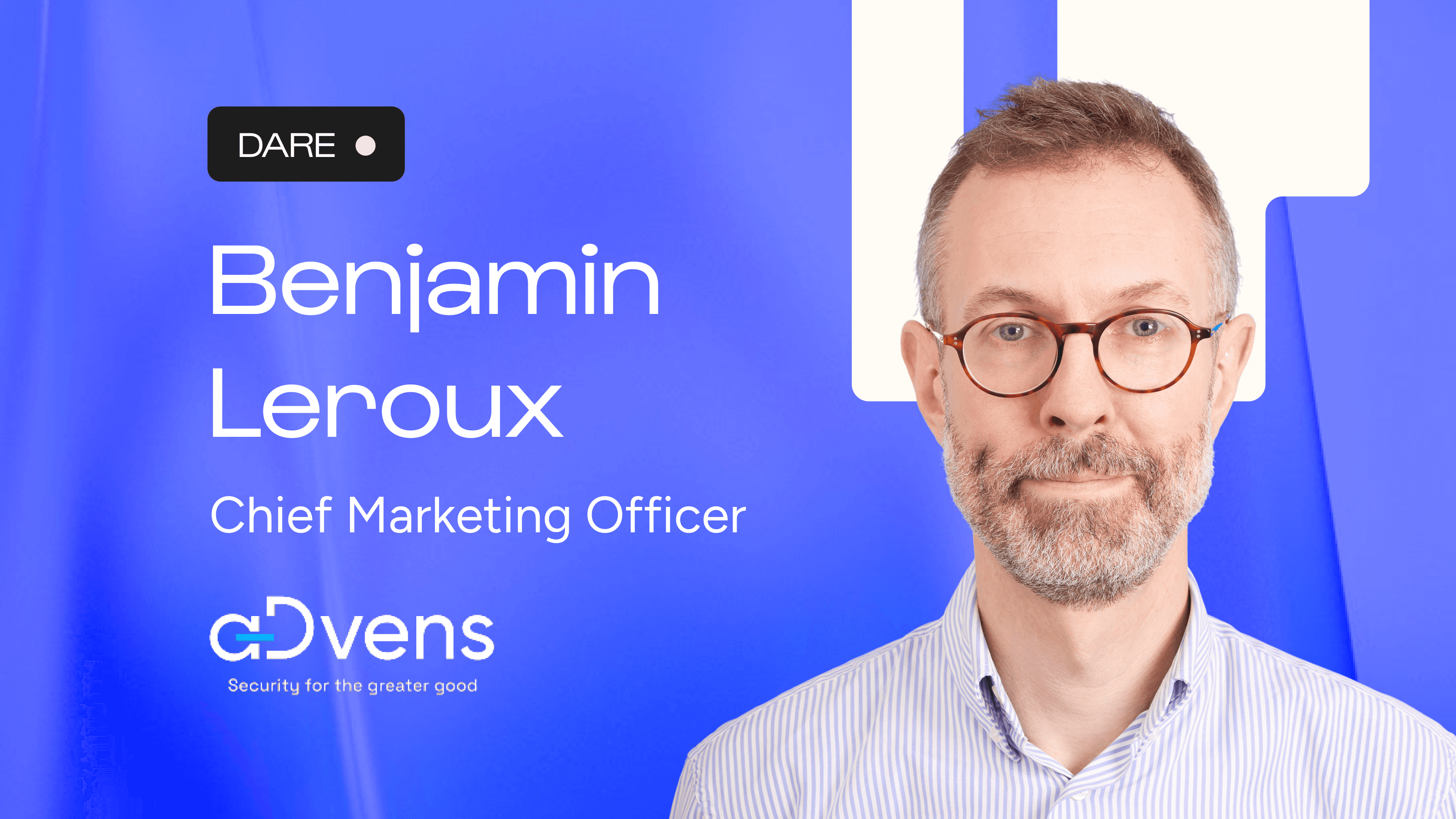
DARE #6 - Benjamin Leroux - CMO @Advens
Dec 1, 2025
Sometimes, we meet people who inspire us. Who make us believe that another approach is possible. Who take us into their energy.
“DARE.” is the series for optimists. Those who have the courage and creativity to constantly reinvent our businesses and daily lives.
Immerse yourself in the universe, strategy, and methods of those who are moving the lines.
Strong personalities for concrete interviews.
Defend to advance
Curious engineer turned strategist, Benjamin has made security a lever of value, not a hindrance.
From his beginnings tinkering with networks at Télécom Sud Paris to embodying the vision of Advens, he traces a path guided by curiosity, clarity, and impact.
For him, cybersecurity is not just a technical matter: it is a mission of protection, a driver of progress. He advocates for a cyber optimism, committed, rooted in reality — where pedagogy and meaning take precedence over fear and constraint.
Benjamin embodies a simple conviction: securing is enabling innovation.
Benjamin, let’s start at the beginning. What brought you to cybersecurity?
I had a fairly classic path: preparatory classes, engineering school at Télécom Sud Paris, but what really hooked me was the tinkering aspect. It all started with LAN parties with friends, where we spent more time configuring the network than playing because it never worked! 😂
I eventually joined the school's geek association that managed the student residence network. We managed everything ourselves: Linux servers, Internet access, we witnessed the development of peer-to-peer… It was up to us to redirect students who were downloading strange content. I learned almost more from doing that than from attending classes, as we were grappling with ultra-field problems.
These experiences especially allowed me to realize that I really liked computing, but I didn't want to be a developer. I did some coding, and I developed websites to make ends meet during my studies, but I was more interested in the admin/system part.
Finally, I loved the fact that security encompasses many disciplines. I felt that you had to be able to touch a little bit of everything to prevent machines from taking control, like in Terminator 2.
Terminator 2 as a career trigger, that’s original!
Yes, but it’s serious!
I have a very human perspective on the internet and computing. The potential and benefits are considerable, but the risks are too. I was impacted by the character of Skynet. What happens the day robots take control? That stayed with me.
But that’s what’s fascinating about this sector. It goes much further than just technique. It’s extremely cross-sectional and profound. It touches on all layers of the system.
So in 2004, Télécom Sud Paris (formerly the National Institute of Telecommunications) launched a pioneering option in Security of Systems and Networks. The program was designed by someone from Cisco, who brought us very concrete and business-related subjects. We had the intervention of many Chief Information Security Officers, people from the ancestor of ANSSI, etc. In short, professionals came to tell us the real-life experiences in networks, in IT, in cybersecurity.
I specialized in it with an internship at Sycomore, an IT services entity of EADS Telecom. My subject was already IAM, identities.
And all of this, to ultimately enter the only company I didn’t want to join...
You’re tough! There are worse than Accenture …
I'm joking. But for me, they represented a bit of the stereotype of the suit-and-tie company that did SAP.
What made you decide to join them?
They had a global technology practice that made me dream. "We’re going to take you to build huge systems infrastructures, megaprojects..." That turned my head. And above all, they had a dedicated security team which was one of the few entities to be international.
Furthermore, I must admit that the very strict nature of the recruitment process, the demands, reminded me of prep years. Being a good student, that attracted me.
The first major project I worked on was the online tax declaration. At the time, it required an electronic signature. I worked on the whole "administration of proof" aspect.
These were projects with a lot of cryptography, PKI, certificates… They had created everything from scratch: a signature module designed for the general public, a PKI infrastructure that issued millions of certificates during the two months of declaration, etc.
It was technical because a tax declaration doesn’t last long, so you have to manage a huge flow of data in just two months. We experienced the construction of the platform. At that time, I was mainly focused on performance testing. It was only later that I evolved into cybersecurity topics, but always in the public sector. In terms of a playground, it was huge.
It must have been quite thrilling to grapple with such a world and at such a scale of projects!
Indeed! Especially since I wasn’t old. I wasn’t even 30, and I was being sent to present certain analyses to the Ministry of Finance, the Military, the Interior, etc.
My interlocutors were named Paul Dupont and had Yahoo addresses because they actually worked for the secret services.
I loved this chapter of my career for the significant stakes of the missions we undertook and because it allowed me to truly dive into the world of cybersecurity.
What led you to change companies then?
The call to join a smaller structure, a little less political, already. But also a company 100% dedicated to security, where Accenture wasn’t focused on Cyber.
I then went to a publisher of a technology brick for electronic signatures that we used in the tax project. It was called Dictao before becoming Idemia.
It’s a company that deals with transactions, dematerialization, papers, electronic passports, electronic signatures, etc.
At the time, it was a small business, but it had been launched by Jacques Pampin, one of France’s great entrepreneurs of the time who specialized in electronic certificates.
I was quickly put on a major project of securing operations for the Ministry of Justice, specifically the penitentiary administration. It was exciting to visit prisons and see how to secure their operations.
I did that for a while, but having just had a child, I felt the need to slow down a bit. However, the idea of becoming a CISO intrigued me. I was curious to cross to the other side of the mirror to take the reins and no longer intervene as a service provider.
I then joined ALD’s subsidiary of Société Générale as CISO to secure their car leasing and fleet activity. I had a great year there, but I ended up meeting Alexandre, the founder of Advens.
Ah! And a love-at-first-sight?
Indeed. We were just completely aligned in our vision of Cyber.
Our thesis was that cyber should be a source of value and not a vector of blockage and trouble; which was quite innovative at the time.
It was a bit of a leap into the unknown because Advens wasn’t big at that time. We’re talking about a few dozen people spread between a small Paris office and a Lille office.
But I had a good fit, and the local in me was happy to return to Lille. I then joined them as a GRC consultant before co-managing the GRC perimeter a while later.
In the end, one could almost say that consulting is your main thread?
Absolutely! By the way, according to Alexandre, my superpower is being able to easily explain complicated things.
So, the client support aspect, explaining to them what just happened, presenting our conclusions, etc. corresponds well to what they were looking for.
But you are right: after swearing not to do consultancy anymore, I got back into it.
This time in a company where I immediately enjoyed myself at all levels.
In what sense?
First of all, the missions were much faster than those I experienced at Accenture. Things moved much faster, allowing me to discover more use cases.
Secondly, it was fascinating from a strategic perspective. I have a very strong inclination towards macro vision topics; almost more than the details of operations.
This allowed us to create a very strong intellectual connection with Alex. We spent a lot of time discussing those topics. It’s worth noting that Alex had a vision for where he wanted to take security back in 2000. You had to be able to project yourself to follow him in his ideas!
Ultimately, it was his rejection of public speaking that led me towards marketing.
Having no particular opposition to it personally, I often found myself conveying the messages and vision of the company within the Cyber ecosystem. At the time, we were already very active in the ecosystem, particularly within the organization that became CESIN.
In short! I was an engineer and had only ever done security consultancy, but I ended up as Marketing Director.
Has the fact that you’ve never done marketing held you back?
Perhaps in the sense that it’s a profession with a certain technicality that I had to learn on the job, with few resources. The learning curve was steep at first. However, I believe that my technical expertise in Cyber was a considerable asset in content creation.
We were heavily involved in organizing events, webinars, round tables, deliverables, etc. for which my convictions and job knowledge helped a lot. We were able to position ourselves on topics nobody was talking about at the time. I’m thinking particularly of the study dedicated to the stress of CISOs with CESIN. That was unprecedented back then.
Generally speaking, we really tried to be catalysts for reflection for the ecosystem, not in a sales perspective but from a sincere contribution standpoint.
This has been extremely beneficial for Advens and its image. It allowed us to spread our values of humility and technicality in the market. Suffering from the syndrome of the small provincial company, we tended to speak little and provide a lot.
We had and still have an obsession: to surprise with the value of our content. The feedback we’re getting from the market is quite good to date, which is always very gratifying.
This ecosystemic approach is interesting. I imagine it also helps you stay abreast of market developments?
Absolutely! Whether through monitoring or mentoring new projects, I constantly grapple with new ideas as they emerge.
This is essential, especially in Cyber, where we are at the confluence of all possible and imaginable evolutions. We must constantly digest a huge quantity of mutations, whether technological, geopolitical, legal, etc. because it is up to us to secure the entire chain.
It’s tough because we deal with sharp, heavy subjects in development, which can lead to a certain apathy. That’s what happened during the cloud era. There was a lot of reluctance in the sector on the subject. We feared we wouldn’t be able to access our data if it wasn’t in our data centers, etc. but we had to get on board.
It’s the same struggle we’re experiencing today with AI. There’s no way to miss the train. So we must constantly engage with new solutions.
I admire your enthusiasm for the job after over 20 years in the sector. Have you ever succumbed to cynicism?
It’s true that sometimes there’s a depressing side. Do you know any industries where you spend your time buying solutions?
Imagine for a moment transposing the dynamics of cybersecurity to automotive: you buy a car, but you’re not sure if the brakes work or if the seatbelt will stop you... So in addition to your car, you buy another airbag from SentinelOne and another seatbelt from McAfee!
But I prefer to see this constant challenge as an opportunity. We are constantly required to understand the specifics, the evolution of the regulatory framework, new usages, the organizational aspect, etc. ...
All of this means that after more than 20 years in the sector, I continue to have a blast. Beyond the technical aspect, these developments reflect much deeper technological and societal issues.
Then again, it’s true that you have to make peace with being a defender. We are like guardians. If you concede a goal, it’s the end. It’s somewhat thankless.
Where do you draw your optimism from?
Beyond its intellectual richness, I find a lot of meaning in our professions. I push the reflection far, but we truly have a protective dimension similar to what firefighters offer.
And we’re not talking about fluffy concepts far from reality. We’re talking about technology that the whole planet uses daily. The phones we have in our pockets, the computers we type on all day long, my children's gaming consoles, and so on.
We are here to ensure that we can collectively benefit from the added value offered by new technologies.
Because in the end, that’s what technology is for: to open doors and discover new things. It allows us to get rid of the boring and free up time for the interesting.
I remember experiencing the arrival of the internet in high school. When for the first time, I was able to chat with someone on the other side of the planet. It was crazy. From northern France, I was talking to a Quebecer from a band we liked. We had just opened a window to the world.
And it’s endless because every technological evolution comes with its share of promises. So to answer your question, sure there are dark sides, but also an endless flow of benefits for Humanity that I am lucky to defend every day.
Very inspiring. There’s almost a legacy dimension in what you say…?
Absolutely! I mentioned earlier, our generation had the extraordinary chance to witness the emergence of the internet.
This launched an unprecedented explosion of creativity. I also recommend listening to the podcast “The History of French Touch” from Radio France, which discusses the rise of French icons and artists made possible by computing. It talks notably about Daft Punk and the revolution of being able to produce music from home.
But it went much further with the emergence of blogs, the first websites, online video games, etc. Everyone was able to create their little piece of the internet, and it was extraordinary.
So yes, it’s clearly a chance we had and that I wish to pass on to future generations.
Values seem to be an important subject for you. Do you identify with those of Advens?
It’s tailor-made!
More seriously, I am very proud to be part of the adventure for several reasons.
The first is that it's a hardworking company. We get the job done. We fight for our clients, and we’re lucky because it pays off. We’ve been growing by over 25% a year for several years now, which is naturally gratifying.
The second is that it’s a courageous company that commits to its teams. And the opposite is often true as well. Keep in mind that Advens is 60% owned by employees - not all, but between 50 to 70 employees, including about ten historical ones. The other 40% is two investment funds. Personally, I think it’s an audacious, and especially virtuous model.
And finally, I would mention the societal project of the company. All shareholders, even employees like me, commit to donating a portion of their future capital gains to a donation fund "Advens for People & Planet".
This means that the company’s economic performance directly benefits society.
When listening to you, it sounds like everything is rosy and everything is going well for you. Do you have moments or situations that challenge you more?
Aside from drugs and alcohol, you mean? 😂
That would partly explain your optimism...
I’m joking. One topic that has taken work for me has been learning to gauge my capacity for work; not to get overwhelmed. When you have a positive nature and love what you do, you want to say “yes” to everything, but you risk burning out and leaving your team stranded.
I would also add that you need to evaluate your ability to advance projects of which you are not the sole bearer; which is very different. Everyone has their subjects and priorities. Not all teams will necessarily have the same level of involvement at any given moment. That’s also something I had to learn to manage.
Lastly, I think I had a somewhat “pure” side. I could lead a project for the sake of it; because it seemed interesting and in the sector's interest, but I lost sight of ROI.
Not coming from marketing originally, those are some reflexes that weren’t very ingrained in me. I had to refine them, although overall I haven’t faced too many projects that ended up crashing… In the end, things are rolling, awareness is increasing, the business is growing, etc. In short, with experience, you ultimately learn to trust yourself.
Do you have any rituals or productivity hacks?
Not really, other than that I am very strict about time. How you manage it, how not to block teams, etc.
So no matter what I’m doing, if a team member messages me, I try to respond right away to help them move forward. There may be times I ask for a moment to think, but I try not to interrupt dynamics.
Otherwise, I believe a lot in the importance of investing time in pedagogy towards collaborators. It takes a little more time, but if you explain well the why and how of projects, you end up gaining in execution speed and impact.
Benjamin, thank you for all these very actionable insights. I’m arriving at my last two questions. Do you take particular pride in your journey?
I am particularly proud of the study on CISO stress we talked about earlier. It had a lot of impact and was very well received by people who were finally able to pinpoint issues.
Otherwise, I am also very attached to the evening we organize for the FIC. It started from a simple observation: many people arrived the night before the event in Lille but spent the evening alone in their hotel. I told them: "Instead of getting bored in your hotel, come have a beer at Advens." And it has become an institution!
Today, this evening brings together over 120 people every year, and it has its regulars! People enjoy coming, so they talk about it. It started from something simple: welcoming people we know and like.
Awesome! And to finish, a piece of advice you would give to your "you" from ten years ago?
I’m not saying it in a boasting way but more to bring calm: trust yourself.
I’m someone who operates a lot on values and instinct. I’ve had periods of doubt, but overall I’ve let myself be guided by my guts, and I’m happy with the journey I've taken.
I love what I do, and as long as that’s the case, I will be able to trust myself.
Thank you, Benjamin!